
Screening Hydrogen Compatibility of Pipeline Steels and Welds
Published in EPRI Workshop on Hydrogen Embrittlement 2024, Jesus College, Oxford, UK, 2024
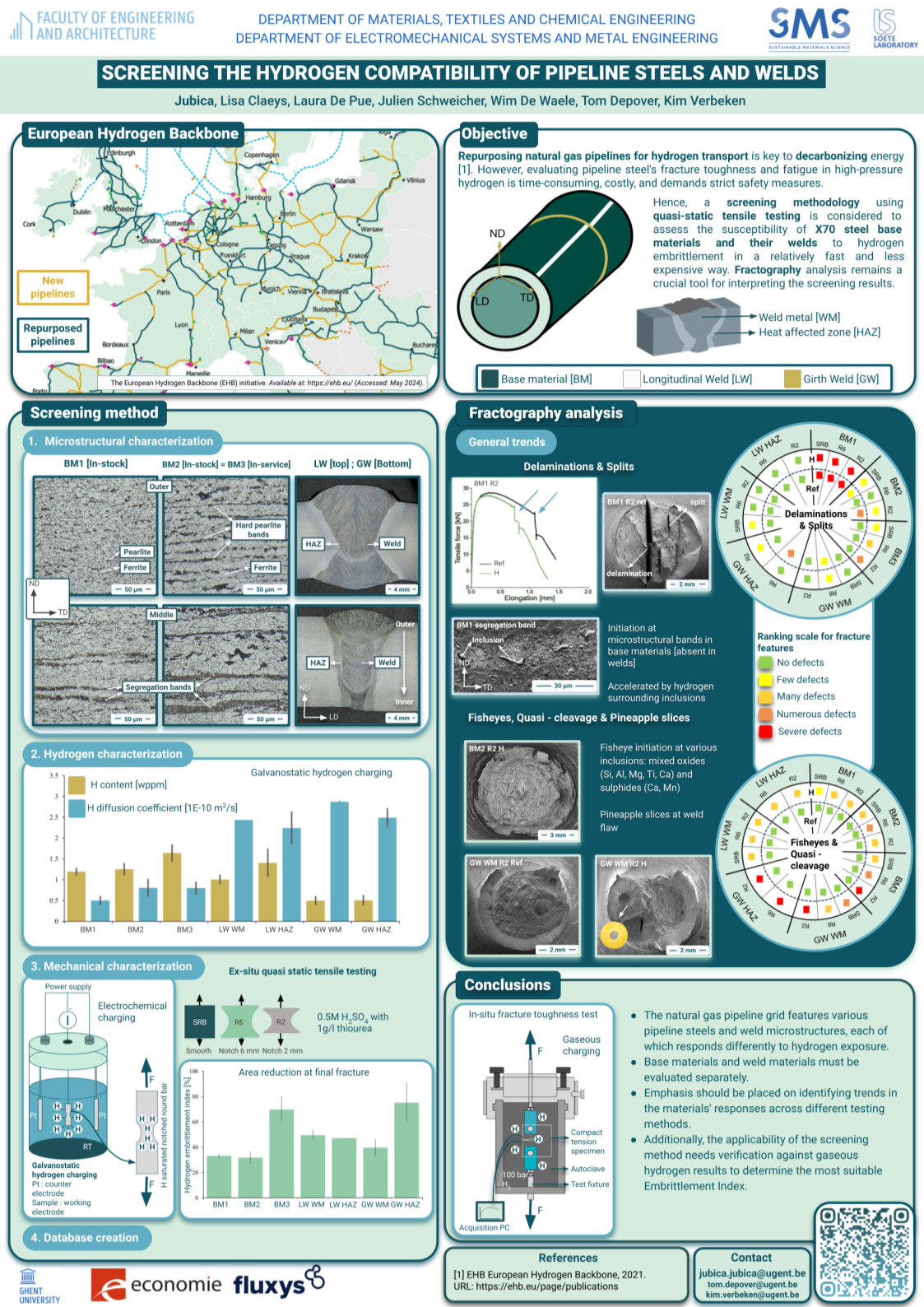
Project Overview
This project focuses on the critical issue of hydrogen embrittlement (HE) in pipeline steels, a significant challenge for repurposing natural gas pipelines for hydrogen transport. The work establishes a screening methodology using quasi-static tensile testing to evaluate the susceptibility of X70 steel base materials and their welds to HE in a time and cost-efficient manner.
The research also provides a comprehensive overview of using gaseous additives, such as oxygen or carbon monoxide, as inhibitors to mitigate HE. The findings highlight that gaseous inhibitors can decelerate hydrogen adsorption kinetics and reduce hydrogen-accelerated crack growth by competing for surface adsorption. A continuous supply of these inhibitors is essential for sustained mitigation.
Key Methodologies and Findings
- Microstructural Characterization: The study utilized techniques such as Light Optical Microscopy (LOM), Scanning Electron Microscopy (SEM), Electron Backscatter Diffraction (EBSD), Energy Dispersive X-ray Spectroscopy (EDS), and X-ray Diffraction (XRD) to characterize the material.
- Hydrogen Characterization: This involved galvanostatic hydrogen charging, measuring hydrogen content, and determining the hydrogen diffusion coefficient.
- Mechanical Testing: The research conducted ex-situ quasi-static tensile tests and assessed the area reduction at final fracture to determine the hydrogen embrittlement index.
- Gaseous Inhibitors: The work concludes that more electronegative gaseous species than the hydrogen molecule can reduce hydrogen adsorption kinetics. A continuous supply of these inhibitors is crucial for sustained mitigation, and increasing their concentration improves the level of HE mitigation.
Conclusions
The research shows that the natural gas pipeline grid features various pipeline steels and weld microstructures, each of which responds differently to hydrogen exposure. Therefore, base materials and weld materials must be evaluated separately. The screening method’s applicability needs to be verified against gaseous hydrogen results to find the most suitable Embrittlement Index.
Author Contributions
As a key contributor, I was responsible for the investigation, methodology, validation, visualization, and writing of the original draft for the research paper on gaseous inhibitors.